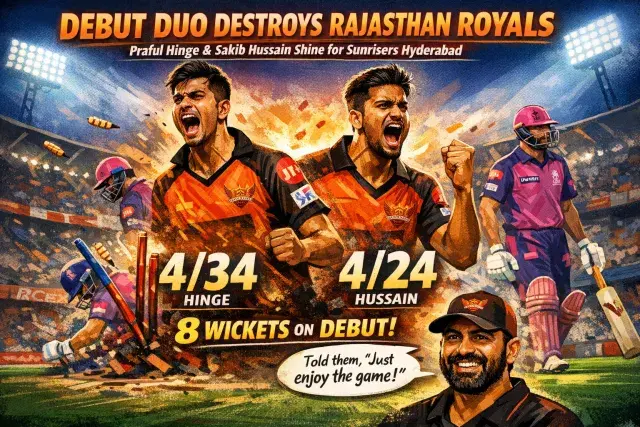
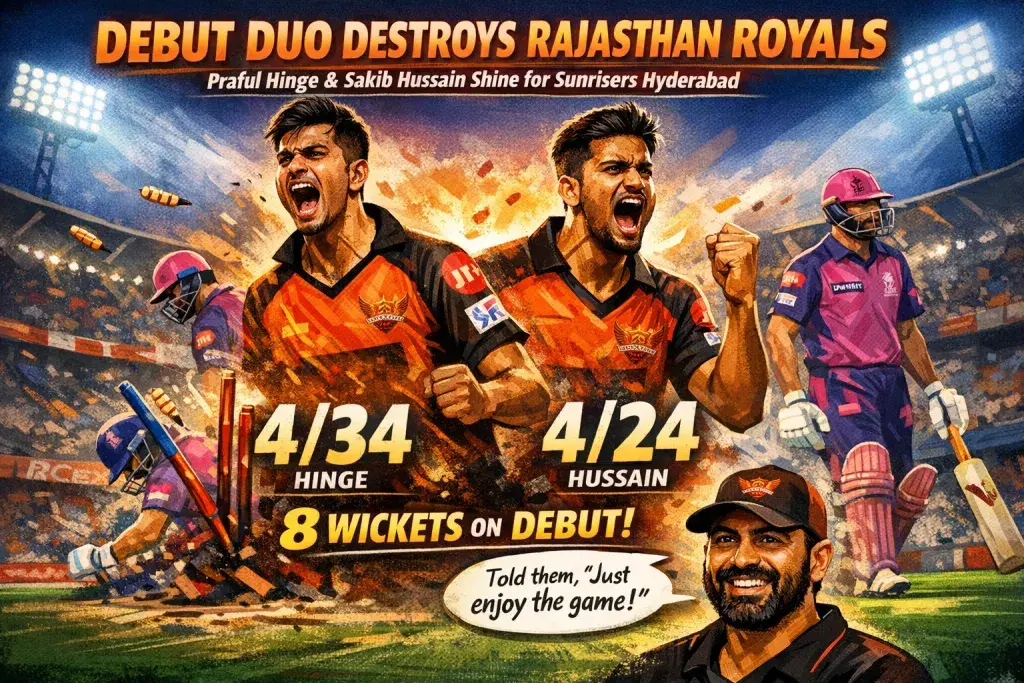
Four wickets apiece from first-time IPL performers Praful Hinge and Sakib Hussain handed Sunrisers Hyderabad a 57-run victory over Rajasthan Royals in Hyderabad on April 14, as the home side dismissed their opponents for 159 while defending a total of 218. The result marked SRH's second win of the current IPL season and represented one of the more striking individual debut performances the competition has seen in recent memory.
The Significance of Making History on Debut
Praful Hinge's opening over was, by any measure, extraordinary. He dismissed three Rajasthan batters in a single over — the first bowler in IPL history to achieve that feat in the opening over of an innings. He finished with figures of 4 for 34 across his four-over allocation. That kind of entry into professional franchise cricket is rare not because talent is scarce, but because the pressure of a debut in a high-profile environment typically suppresses performance rather than unlocks it.
Sakib Hussain, who entered the contest as an Impact Sub for Travis Head, was equally decisive. His 4 for 24 included the wicket of opener Yashasvi Jaiswal — a significant early breakthrough — before he dismantled the lower order to finish with identical wicket figures to his fellow debutant. Together, they accounted for eight of the ten wickets that fell as Rajasthan were dismissed in 19 overs.
Mindset Over Mechanics: The Coaching Philosophy Behind the Performance
SRH pace bowling coach Varun Aaron, who played a central role in identifying both young fast bowlers, offered a candid account of his pre-match approach. His directive was deliberately simple: enjoy the occasion rather than chase an outcome. "My only plan for them was to just enjoy the game because you debut only once in any format of cricket," Aaron told reporters. "My only plea before the game was that if I didn't see them enjoying it, I'd be really angry — and they truly did enjoy it."
This philosophy reflects a well-established principle in performance psychology. Anxiety management in high-stakes debut situations often hinges not on suppressing nerves but on reframing the emotional stakes of the event. By anchoring the experience to enjoyment rather than expectation, Aaron effectively reduced the cognitive burden that typically accompanies a first professional appearance at this level. The approach was not accidental — it was deliberate mentorship from someone who understood the psychological weight of a debut from personal experience as a former Indian fast bowler.
Conviction, Communication, and the Value of Player Autonomy
Beyond the general philosophy, Aaron revealed a specific tactical exchange with Praful regarding Vaibhav Sooryavanshi. Praful had proposed bowling around the wicket; Aaron recommended staying over the wicket instead. Praful complied — and took the wicket. Aaron was careful to assign credit accurately. "The plan was his, the conviction was his," he said. "He said, 'I've gotten Vaibhav out before, I'm going to get him out today.'"
That distinction matters. The exchange illustrates a model of coaching that values dialogue over instruction — where the senior figure provides a framework but preserves the young performer's sense of ownership over their own decisions. The outcome validated both the tactical choice and the broader relationship between the two. It also reflects a growing understanding within professional development environments that performers who feel heard and trusted tend to execute under pressure more effectively than those who simply follow orders.
What the Performance Reveals About Talent Identification and Development
The emergence of Hinge and Hussain raises a broader point about the pipeline of fast bowling talent in Indian cricket. Both were scouted by Aaron personally, suggesting that the identification process extended beyond the standard recruitment channels. In a system as vast and competitive as India's domestic structure, the ability of a specialist coach to locate and develop specific profiles of fast bowler — rather than relying solely on aggregated performance data — remains a meaningful differentiator.
For two bowlers to arrive at the highest level of franchise cricket and immediately perform at this standard points to preparation as much as natural ability. The conditions, the opposition, the format, and the context all conspired to produce a high-pressure debut environment. That both emerged from it with eight wickets between them, and with visible composure according to their coach, suggests the groundwork laid in training translated effectively when it mattered most.