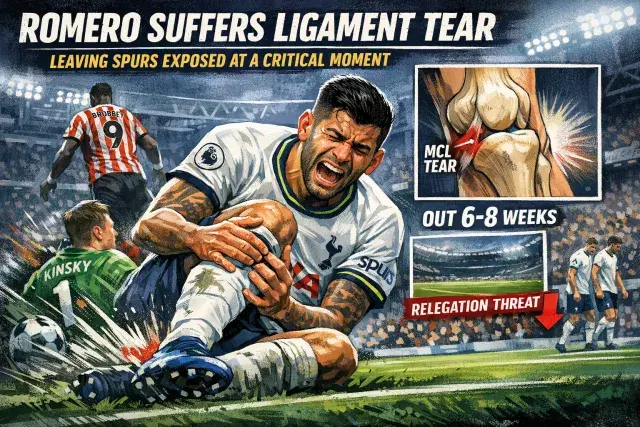
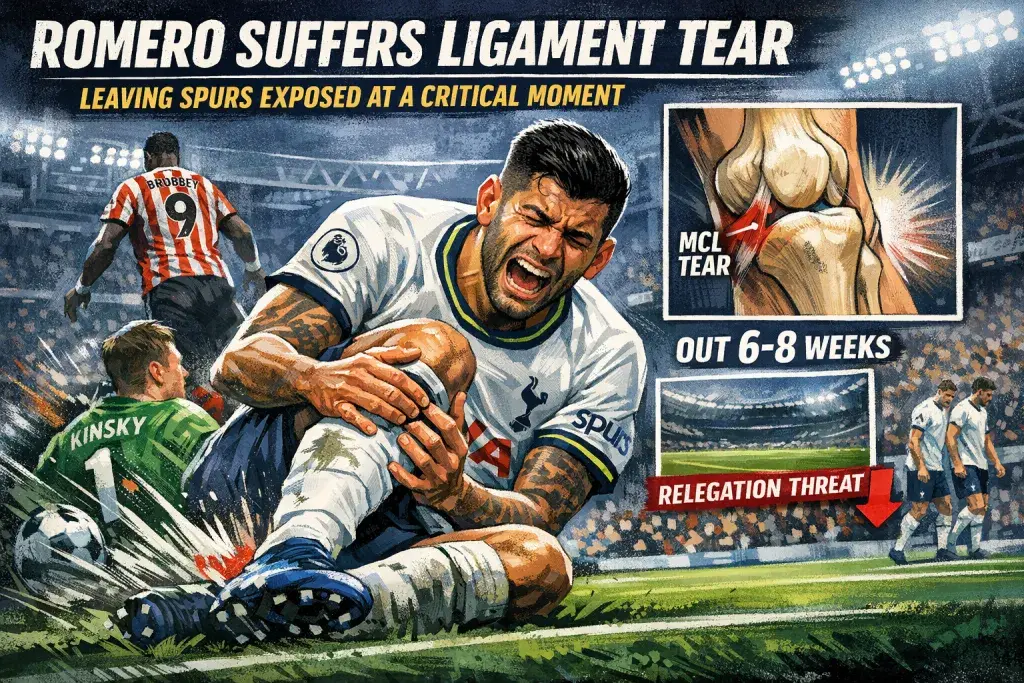
Cristian Romero will miss the remainder of Tottenham Hotspur's Premier League season after scans confirmed a medial collateral ligament tear to his knee, sustained in the 70th minute of Sunday's 1-0 home defeat to Sunderland. The 27-year-old Argentine centre-back was hurt following a physical challenge from Sunderland striker Brian Brobbey, after which Romero collided with his own goalkeeper, Antonín Kinský, and immediately clutched his knee in visible distress. The injury arrives at the worst possible moment for a club currently sitting 18th in the table, with six fixtures remaining and relegation a genuine prospect.
The Anatomy of the Injury and What Recovery Looks Like
The medial collateral ligament runs along the inner side of the knee, connecting the femur to the tibia and providing lateral stability during movement and physical contact. It is one of the more commonly injured knee ligaments in professional football — not because of any structural weakness, but because lateral force to the knee, whether from a collision or an awkward landing, places the MCL under acute stress. Unlike the anterior cruciate ligament, MCL tears rarely require surgical intervention. Conservative management — rest, progressive physiotherapy, and gradual load-bearing rehabilitation — is typically sufficient for most grades of the injury.
Clinicians generally classify MCL tears across three grades. Grade I involves microscopic fibre damage with no structural instability. Grade II represents a partial tear with some looseness in the joint. Grade III is a complete rupture, often requiring a longer recovery window and, in some cases, surgical support. A confirmed timeframe of six to eight weeks places Romero's diagnosis most likely in the Grade II category, though the precise severity has not been publicly disclosed. At that recovery pace, he will not feature for Spurs again this season — but he stands a realistic chance of being fit for Argentina's World Cup campaign, which opens on 11 June.
Structural Vulnerability at a Defining Moment
Romero's absence strips Spurs of their most assured defensive presence at precisely the point when defensive coherence matters most. The club has conceded the equalising factor in several recent results, and losing a centre-back of his experience and physicality to injury compounds an already precarious situation. The irony of the goal that settled Sunday's result — Micky van de Ven's deflection of a Nordi Mukiele shot into his own net — underlines the fragility of a backline that must now reorganise without its defensive anchor for the rest of the campaign. A trip to Brighton & Hove Albion this weekend represents the first test of that reconfiguration.
For Roberto De Zerbi, Sunday's win at Spurs was his first in charge of Sunderland, though the result has been partially overshadowed by subsequent events. Sunderland remain in the relegation zone, meaning the three points are valuable but insufficient on their own to change the broader picture.
Online Abuse and the Response That Followed
After the final whistle, Brobbey posted images from the fixture on his social media accounts. The response was swift and deeply troubling: hundreds of abusive and racist comments flooded the posts, with the bulk of the hostility originating from Argentina, apparently in reaction to the challenge that preceded Romero's injury. Sunderland Football Club subsequently reported the abuse to the police, to social media platforms, and to the Premier League.
The incident is not an isolated one. Cross-border online abuse directed at professional sportspeople following on-pitch incidents has become a recurring and increasingly documented problem, with social media companies repeatedly criticised for the pace and consistency of their moderation responses. The involvement of law enforcement — even across jurisdictions — reflects a broader shift in how clubs and governing bodies are treating digital abuse: not as an unfortunate side effect of public life, but as a reportable offence. Whether that reporting leads to meaningful consequences remains, as with most such cases, an open question.
Brobbey himself has not publicly commented on the abuse.